When extending an existing patio, path or driveway, decide whether you want the new area to blend in or look deliberately different. Neither approach is automatically better. The useful comparison is between real samples beside the existing surface, with a clear drawing of where the two areas meet. A close colour match alone does not settle the layout, levels or preparation.
For block paving, Staines homeowners can begin with what they want to retain and what extra space needs to do. M&R Property & Paving Services installs block-paved driveways, patios and pathways, with colours, patterns and borders chosen around the home and its use. Its patio work includes natural stone and porcelain, while its landscaping brings paving, fences, decking and pathways into the wider garden plan.
Decide what the extra area must achieve
Draw the existing paved outline and add the smallest change that would solve the problem. Perhaps a dining chair currently sits on the lawn, the path becomes awkward beside a parked car, or a seating area does not comfortably hold the furniture you use. Describe that specific difficulty before deciding to extend every edge.
Keep the old and proposed areas visibly separate on your sketch. This makes it easier to see which parts of the existing surface would remain and where new work would meet them. Compare two possible outlines if necessary. A modest rectangular addition and a narrow strip around several sides can create very different junctions, even when they add similar amounts of space.
Check the proposal while the space is in normal use. Put chairs where they are pulled out, leave bins in their usual position and consider the route past them. The extension should solve the everyday problem without leaving a thin, awkward piece of garden between the paving and the boundary.
Test a match beside the existing paving
If matching is the preferred approach, look for any record of the original product, including its manufacturer, colour, size and finish. A spare block or slab can be useful. Give that information to the installer, but do not assume a familiar product name guarantees that new material will look identical beside the surface already outside.
Place a sample at the intended junction and view it from the house as well as close up. Compare the overall tone, the texture and the shape of the units. Notice whether the existing paving looks uniform or varies across the area. A sample beside the least-weathered corner may give a different impression from one beside the main walking route.
Look in ordinary daylight and when the surfaces are wet as well as dry. You are deciding whether the relationship is comfortable to live with, rather than trying to prove that two isolated samples are identical. Do not rely on a phone photograph alone; the same colours can look different on a screen.
Make contrast look intentional
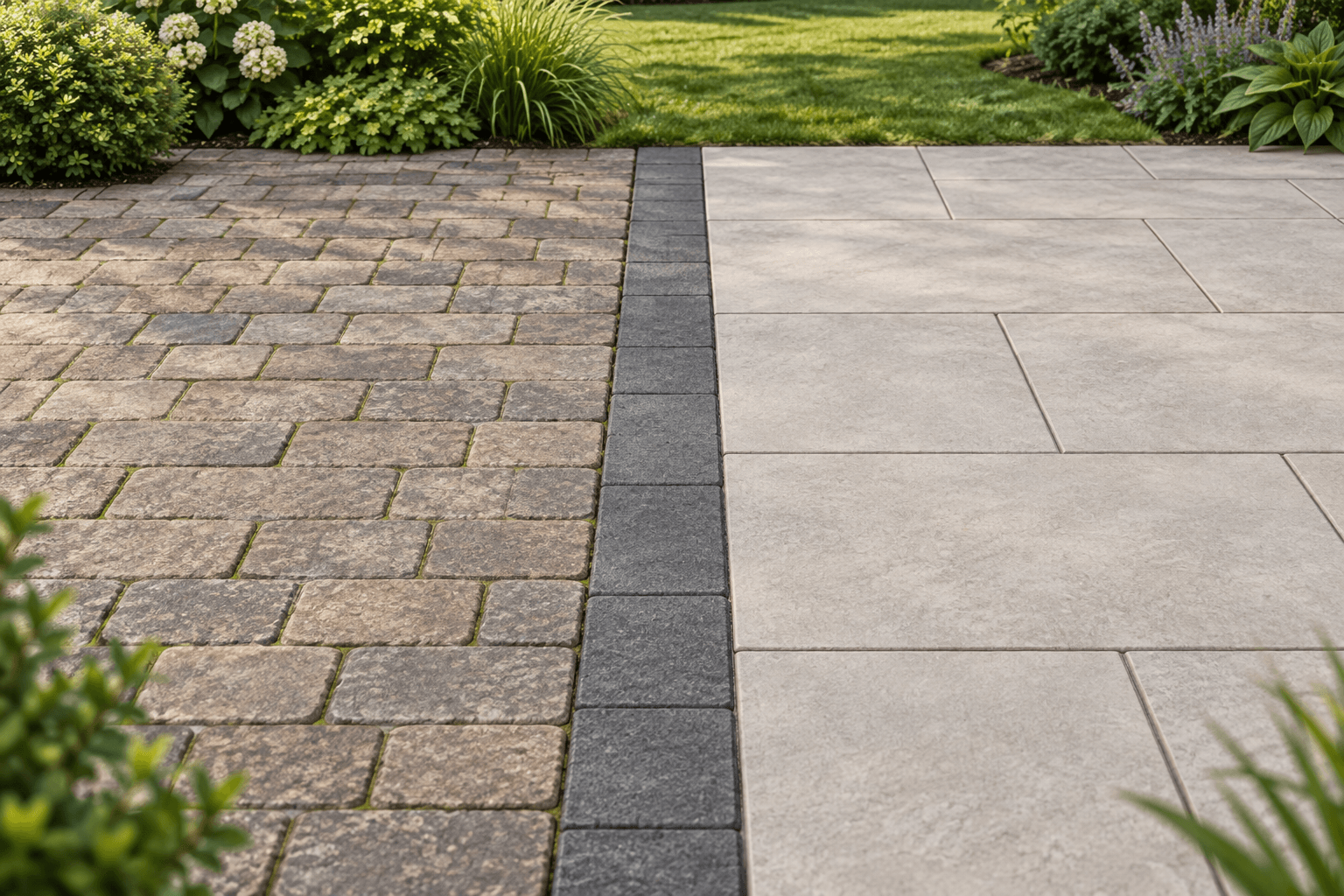
If a convincing match is unavailable, a deliberate change can be easier to understand than an almost-matching patch. Consider a border, a change in laying direction or a clearly defined new area. Keep the number of competing colours and patterns manageable so that the junction has a purpose rather than becoming the busiest part of the garden.
The illustration shows smaller, weathered-looking pavers beside larger pale slabs, separated by a narrow charcoal band. It presents one way to make a change of surface deliberate. It is an educational illustration, not a photograph of M&R work; the actual materials, levels and junction still need to be assessed for your own space.
Ask to see the meeting point drawn, including where the border starts and stops. A strip that works along the lawn may look unresolved when it reaches a doorway or turns a corner. M&R's block paving service includes choices of colours, patterns and borders; those choices are most useful when tested at the edges you will actually see.
Keep the condition and levels in the decision
Wanting to keep the existing paving is a preference, not proof that every part is suitable to retain. Point out visible movement, broken units, puddles and any change you have noticed. Ask which areas need assessment before the extension can be scoped, and whether the proposed junction depends on changing part of the old surface.
Discuss finished levels, nearby doors, steps, inspection covers and where water is intended to travel. A drawing that shows only colour can hide these details. The existing guide to water and paving covers the drainage conversation more fully; for an extension, concentrate on what changes where the old and new areas meet.
M&R's garden pathways guidance identifies route length, width, material, edging, drainage and the connections to the patio, drive or garden as scope factors. The same habit of examining connections helps when an extension changes a route. Ask how the retained surface and the new work will function together before settling the visible finish.
Compare two complete proposals
Ask for the matching option and the deliberate-contrast option to refer to the same intended usable area. Otherwise, a lower price might simply reflect a smaller extension or less work to the original surface. Make the retained and changed parts clear enough that you can point to them on the drawing.
- Identify the existing paving that would remain.
- Show the precise outline of the added area.
- Name the proposed surface and any border material.
- Explain how the new work meets the existing levels and edges.
- State which existing defects need attention within the scope.
- Confirm access and removal of material displaced by the work.
Take the sample comparison and marked outline into the discussion about M&R's garden patios or paving work. They give the installer a concrete choice to assess: how much can sensibly stay, what the extra area achieves and whether the junction should blend in or become a clear design feature.
Questions about extending paving
Is the same colour name enough to guarantee a match?
No. Compare the actual product, size, texture and appearance beside the existing surface. Check more than one position and view the relationship in ordinary outdoor conditions before relying on the name alone.
Does choosing a contrasting border remove the need to assess the old paving?
No. A border addresses how the junction looks. The condition, levels, drainage and suitability of the retained paving still need to be considered for the proposed work.