Most people choose a block paving pattern from a photograph, which is reasonable, because the pattern is the part you see every day. What the photograph does not show is that the pattern also decides how the surface behaves under car wheels, how many blocks get cut at the edges, and how the driveway copes years later when a repair is needed.
M&R Property & Paving Services lays block paving in Ashford and this is the practical version of the pattern conversation: what each layout does, where borders earn their place, and which choices are about looks alone.
Herringbone is the working pattern
Forty-five and ninety degree herringbone are the patterns that lock together under turning wheels. Each block is braced by its neighbours in two directions, so braking and steering forces spread across the surface instead of pushing a single line of blocks along. That is why herringbone is the default for the parts of a driveway cars actually use.
The choice between the two angles is mostly visual. Forty-five degree herringbone draws the eye down the drive and hides slight wobbles in the boundary walls; ninety degree suits square plots and produces fewer awkward slivers against straight edges.
- Herringbone resists turning and braking forces best.
- Forty-five degree suits angled or irregular plots.
- Ninety degree gives cleaner cuts against straight boundaries.
Where softer patterns belong
Stretcher bond, laid like brickwork, and basketweave look calmer and read as more traditional. Under a parked car they are fine; under constant turning they can creep over the years, opening joints in the most-used lines. They belong on paths, patios and the parts of a frontage wheels rarely touch.
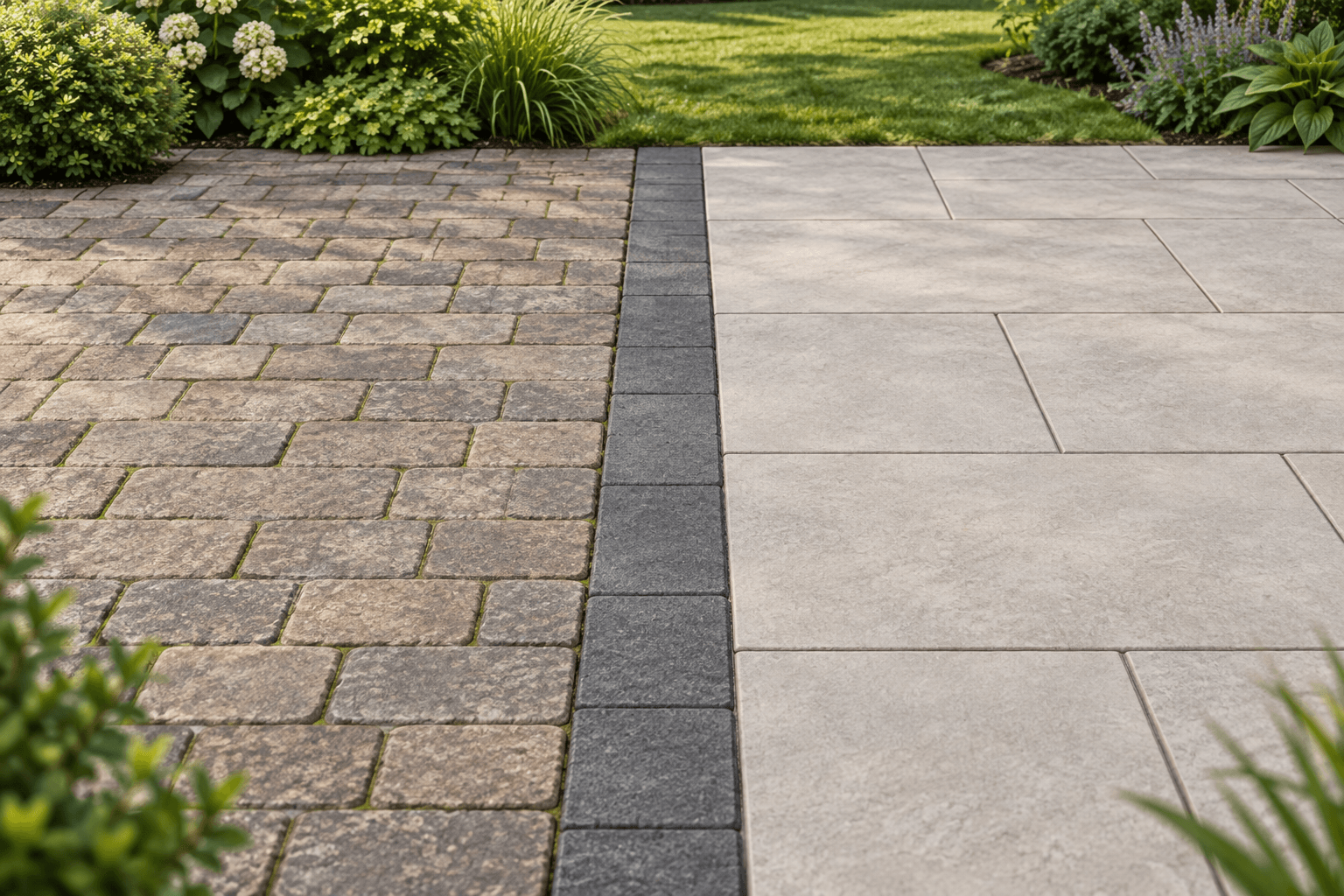
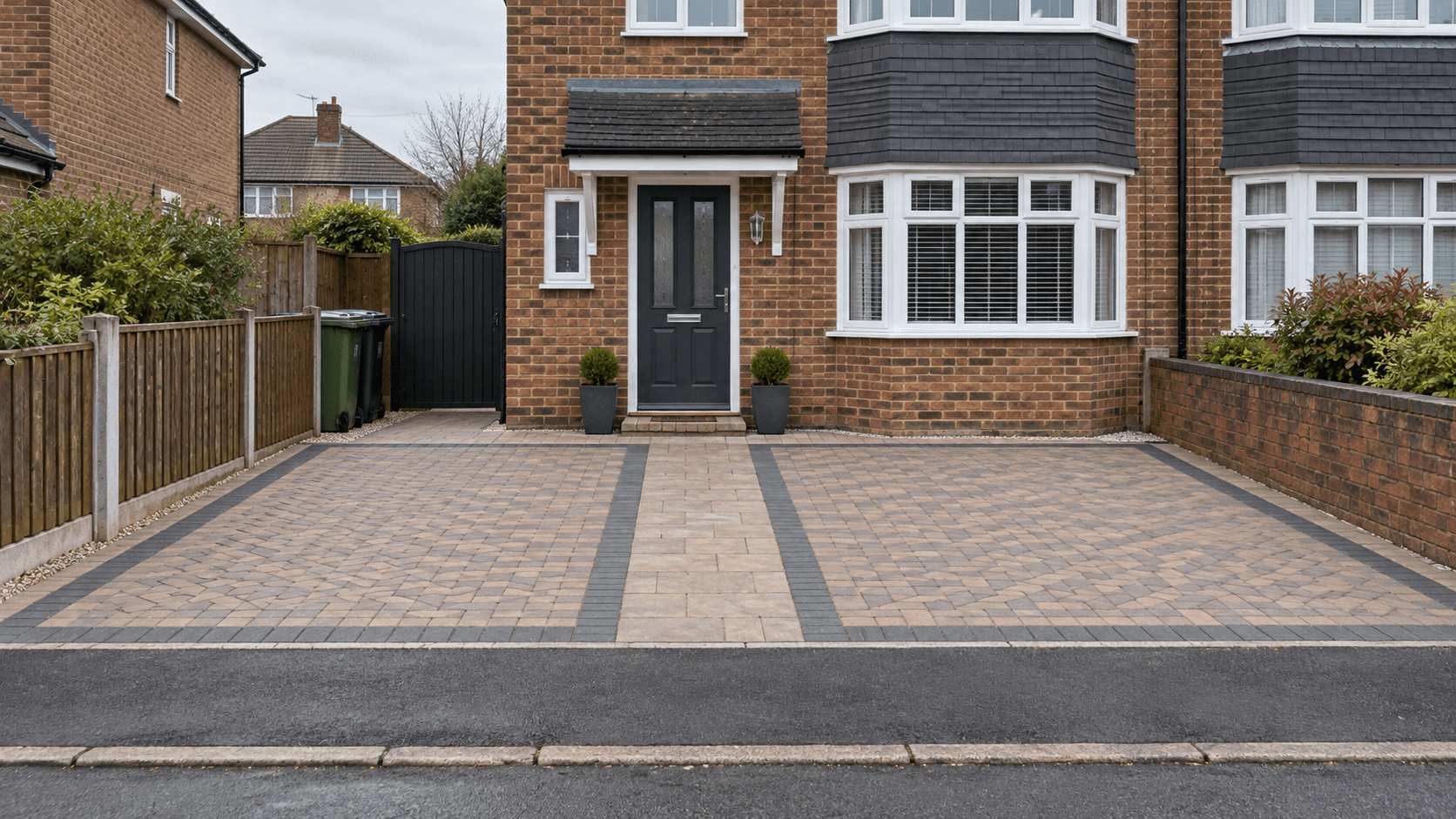
Mixing patterns is legitimate design rather than indecision. A herringbone parking area with a stretcher-bond apron by the door, separated by a border course, gives each zone the behaviour it needs and makes the frontage look considered.
Borders do two jobs
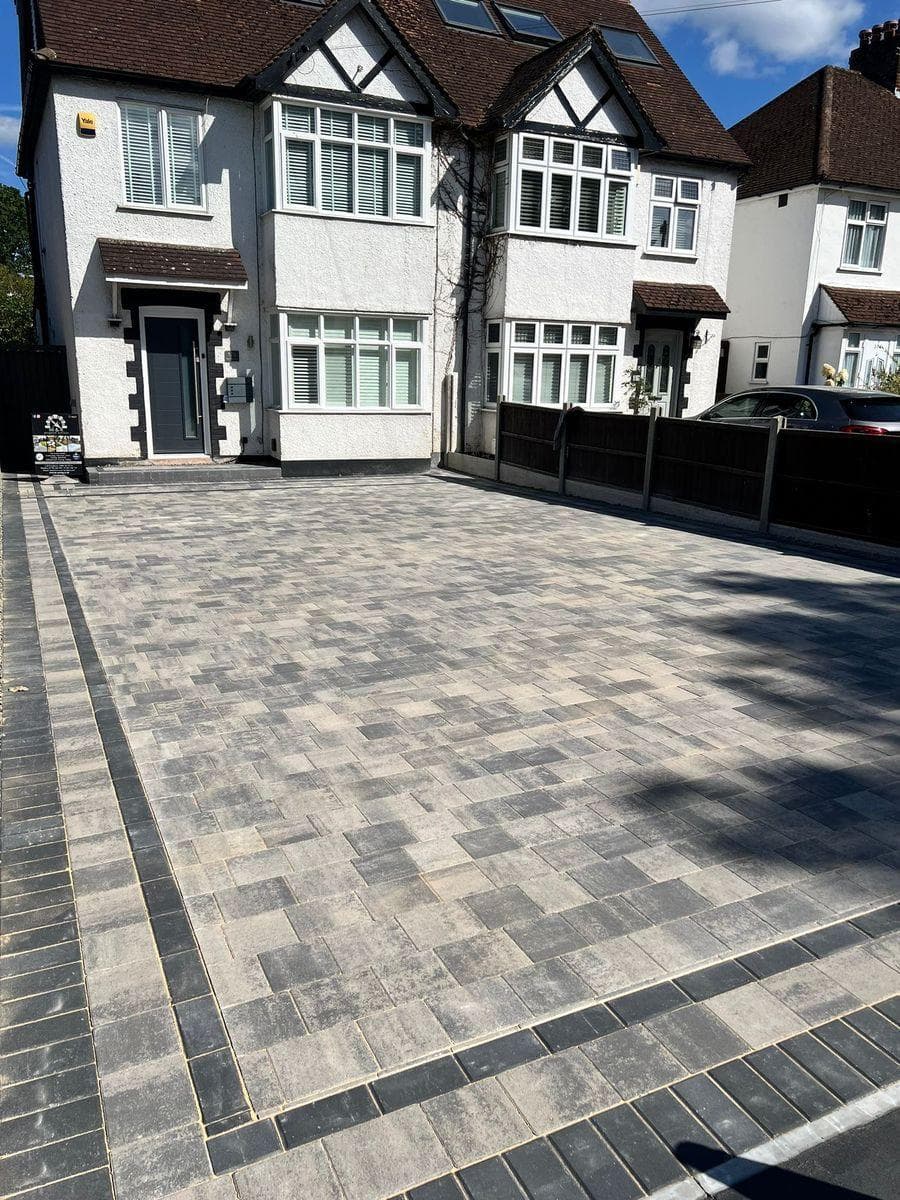
A contrasting border is not decoration first. The edge course, bedded on a firmer concrete haunch, is what stops the whole surface migrating sideways; the colour contrast simply makes a virtue of a structural necessity. A charcoal border around a mixed-grey field is popular in Ashford frontages because it frames the drive and hides the slight colour variation where cut blocks meet the edge.
Borders also manage transitions: where the drive meets a path, where it meets the public footway, and around inspection covers. On M&R Property & Paving Services driveways a recessed cover tray picked out with the border block is the standard answer, deliberate instead of apologetic.
- The edge course restrains the surface; the contrast is a bonus.
- Borders tidy the junctions with paths, steps and covers.
- A single border colour used consistently reads better than several.
Cuts, waste and what patterns cost in blocks
Every pattern meets the boundary somewhere, and that is where blocks get cut. Forty-five degree herringbone produces the most cuts and therefore slightly more waste; stretcher bond the fewest. On a small Ashford frontage the difference is a modest number of blocks, but it is worth understanding why one quote allows more material than another for the same area.
Good cutting is a skill you can see in the finished job. Slivers thinner than a third of a block along an edge suggest the setting out was not planned; a well-set-out drive absorbs the odd dimensions of a real plot into full and half blocks with the border taking up the adjustment.
Related pages
Questions customers ask
Which block paving pattern is strongest for a driveway?
Herringbone, in either forty-five or ninety degree form. The interlock spreads braking and turning forces across neighbouring blocks, which is why the trafficked part of a drive is normally laid this way.
Do I have to use a contrasting border?
No. The structural edge course is required, but it can be the same block as the field. The contrast is a design choice that happens to make the necessary edging look intentional.
Can different patterns be mixed on one driveway?
Yes, and it often works well: herringbone where cars move, a calmer bond by the door or path, with a border course making the change look deliberate.
Choose the pattern for how each part of the frontage is used, let the border do its structural job, and the driveway will look right from the kerb and still be behaving itself years from now.
M&R Property & Paving Services can look at a frontage in Ashford, talk through pattern and border options against how you park, and set out what the job involves. The contact page is the quickest way to start.